
What We Found This Week Reminded Me Why Monitoring Matters
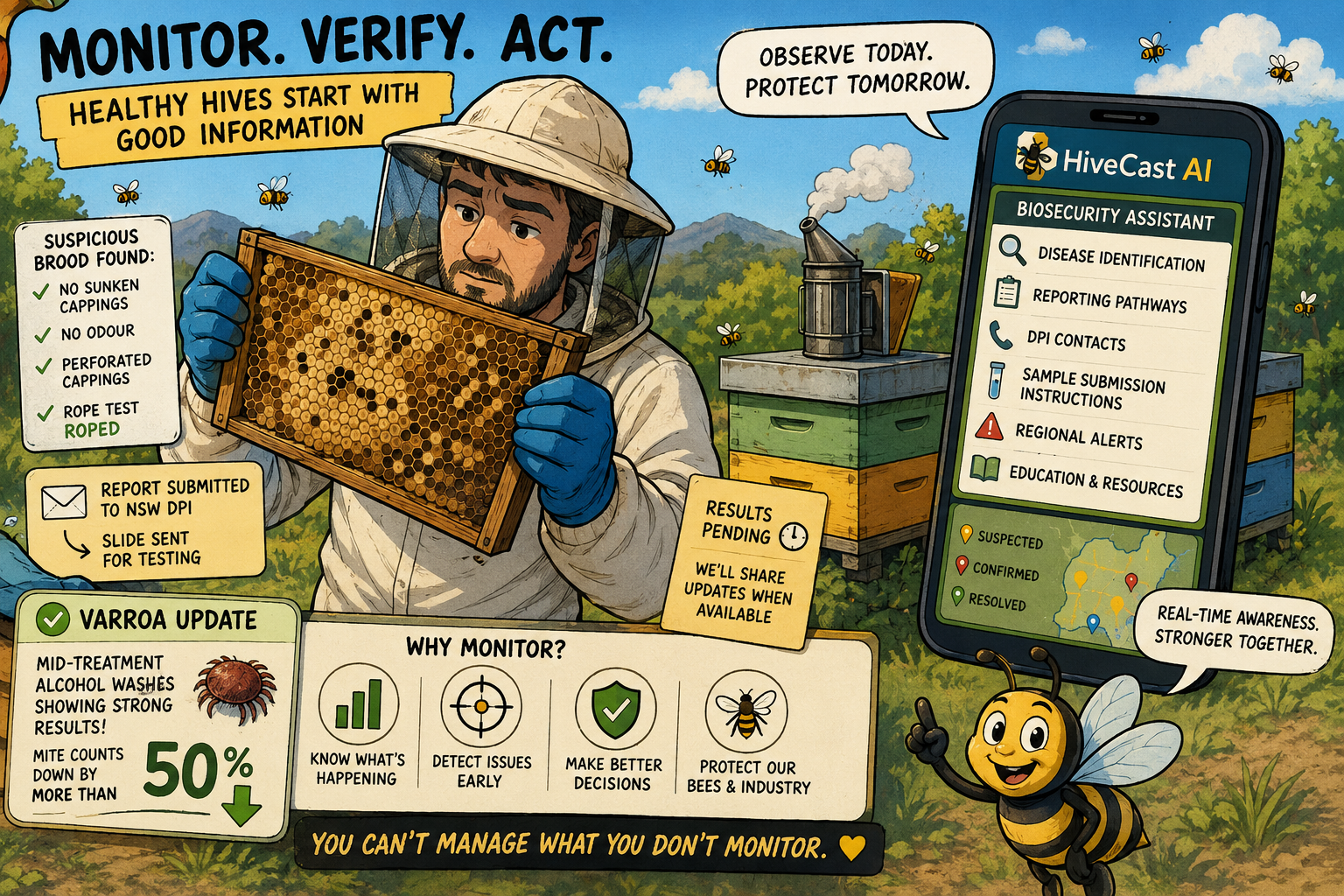
This week, during a routine inspection at one of our McLeans Ridges apiaries, I came across brood that immediately caught my attention.
There were no obvious sunken cappings.
There was no foul odour.
What I did find were scattered perforated cappings and brood that simply didn't look right.
When I performed a rope test, the larval remains roped sufficiently for me to take the situation seriously.
A report was immediately submitted to NSW DPI and a smear slide has been sent for laboratory testing.
At this stage, the cause remains unconfirmed. It may prove to be American Foulbrood, another brood disease, or something else entirely. Until testing is completed, all we can do is follow the correct reporting process and wait for the results.
But the experience reinforced something important.
Monitoring Is About More Than Varroa
Since varroa arrived, many of us have understandably focused on mite counts, treatment schedules and treatment resistance.
Those things are critically important.
However, this inspection was a reminder that every brood frame deserves attention.
Sometimes a hive doesn't present with textbook symptoms.
Sometimes there is no obvious smell.
Sometimes the cappings aren't heavily sunken.
Sometimes all you know is that something doesn't look normal.
Good beekeeping starts by paying attention to those observations.
At The Same Time, We Continue To Monitor Varroa
While investigating this suspected brood issue, we have also continued our regular varroa monitoring program.
Over the past few weeks we have conducted alcohol washes during active synthetic treatment programs across several apiaries.
One of the questions many beekeepers are asking right now is whether treatments are still working.
Based on what we are seeing in our own operation, the answer appears to be yes.
Our mid-treatment alcohol washes have generally shown mite counts reducing by more than half compared with pre-treatment counts.
These observations relate only to our own hives and should not be interpreted as representing every apiary or every mite population. However, the results are encouraging and demonstrate why monitoring remains essential.
Without mite washes, we would simply be assuming the treatments were working.
Instead, we have evidence that mite numbers are moving in the right direction.
The Bigger Lesson
The most valuable information this week wasn't finding suspicious brood.
The most valuable information wasn't seeing mite counts decline.
The most valuable information was knowing what was actually happening inside the hive.
Too often, beekeepers are forced to make decisions with incomplete information.
A treatment is applied but never verified.
A brood pattern looks unusual but is ignored.
A disease concern is discussed online but never reported.
Good biosecurity and good hive management both start with observation, investigation and verification.
Turning Information Into Action
One thing this week's inspection reinforced for me is that information is only useful if beekeepers can access it when they need it.
Most of the resources already exist. Reporting pathways exist. DPI contact information exists. Disease information exists.
The challenge is often finding it quickly when you're standing in front of a hive wondering what to do next.
This is one of the reasons we continue developing HiveCast AI.
While HiveCast began as a platform focused on weather, inspections and apiary management, we increasingly see a role for it as a practical biosecurity and decision-support tool.
Imagine discovering suspicious brood and having immediate access to:
Disease identification resources
Reporting pathways
DPI contact information
Sample submission instructions
Regional pest and disease alerts
Relevant educational material
Not buried in old web pages, forgotten emails or scattered PDFs, but available when it is actually needed.
We also see value in helping beekeepers understand what is happening around them. Not through fear or panic, but through awareness. Where appropriate, HiveCast AI could allow reports of suspected or confirmed pest and disease events to contribute to regional awareness mapping, helping beekeepers better understand emerging risks within their area.
The goal is not more data.
The goal is putting useful information at a beekeeper's fingertips when decisions need to be made.
Whether this week's sample comes back positive or negative, the lesson remains the same:
You cannot manage what you do not monitor.