Confirmed American Foulbrood: A Reminder That Monitoring Is About More Than Varroa
This week, a routine hive inspection at one of our McLeans Ridges apiaries led to a discovery that no beekeeper wants to make.
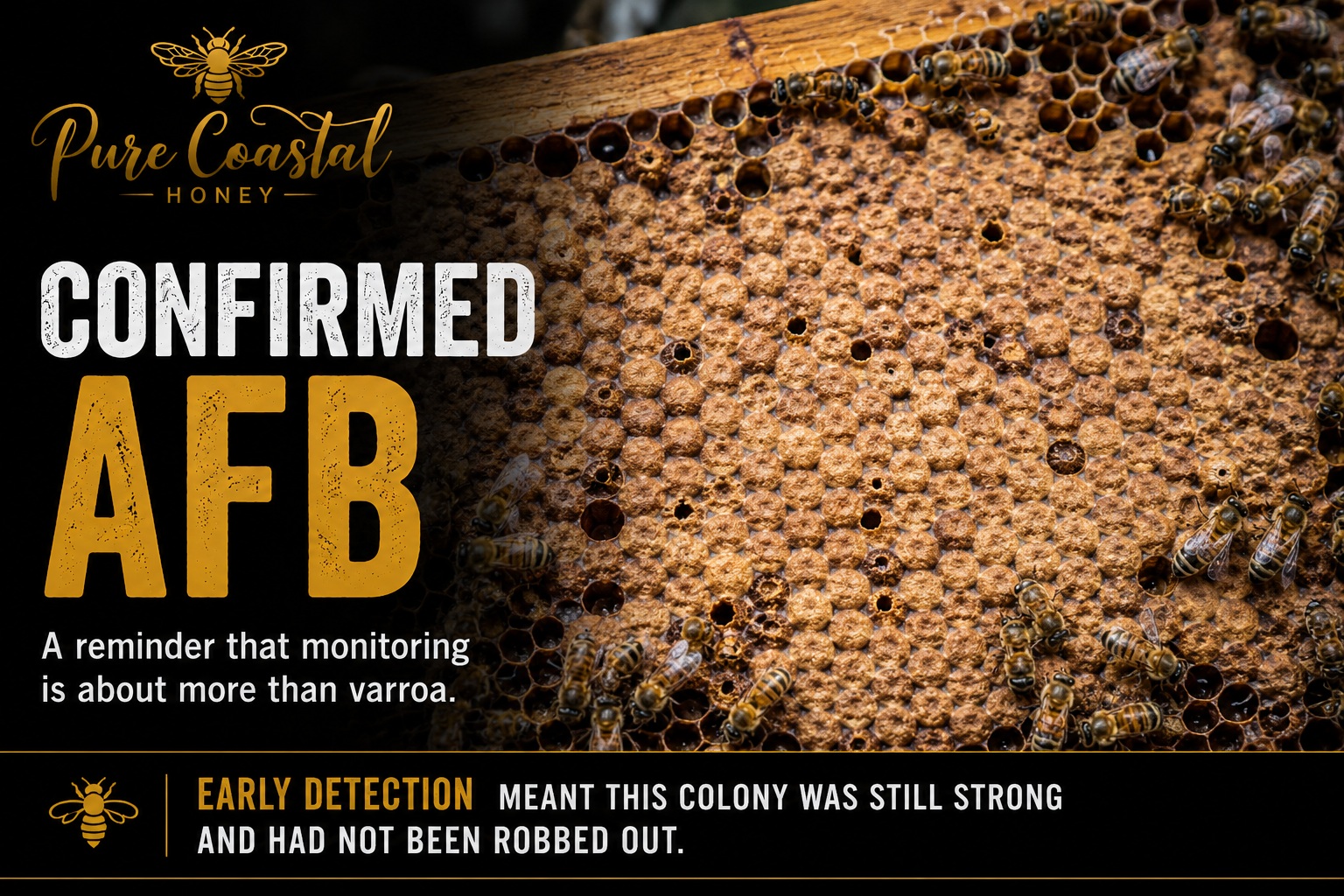
During a brood inspection, several cells raised concerns. While the colony did not display some of the classic signs many beekeepers associate with American Foulbrood (AFB), there were a number of subtle indicators that warranted further investigation.
There was no obvious foul odour and the cappings were not heavily sunken. However, some brood cappings contained small perforations or holes, and there were enough irregularities in the brood pattern to suggest that something was not quite right.
A rope test was conducted and produced a positive result.
Following the inspection, a smear sample was submitted to NSW DPI for laboratory analysis.
On 5 June 2026, the laboratory confirmed the presence of American Foulbrood. The sample tested positive for AFB and negative for European Foulbrood.
Finding AFB is never good news.
However, this experience reinforces several important lessons that extend well beyond a single infected hive.
The Importance of Acting Early
Nobody wants to find AFB in their apiary.
However, this detection demonstrates why routine inspections remain one of the most important management practices available to beekeepers.
Had this colony not been inspected carefully, the disease could have continued to develop unnoticed, increasing the risk of spread within the apiary and potentially beyond.
Early detection provides options.
Late detection often means greater losses.
One positive aspect of this detection was that the colony was still relatively strong when the disease was identified.
Colonies that collapse unnoticed can become targets for robbing by neighbouring bees, potentially allowing contaminated honey and AFB spores to be carried back to other hives. In this case, the disease was detected before the colony reached that stage. The hive remained strong, there was no evidence of robbing activity, and management decisions could be made before the colony became a potential source of wider spread.
While AFB is never a result any beekeeper wants to receive, finding it before colony collapse significantly reduces the risk of robbing events and limits opportunities for disease transmission within the local bee population.
This case also serves as a reminder that not every AFB infection presents as the textbook example shown in photographs. Sometimes the signs are subtle. A few perforated cappings, irregular brood patterns, or simply a feeling that something does not look quite right can be enough reason to investigate further.
This is another reason why regular brood inspections remain so important. Early detection doesn't just protect the affected colony's neighbours—it helps protect the wider beekeeping community.
Varroa Isn't the Only Threat
Since varroa arrived in Australia, much of the industry's attention has understandably focused on monitoring mite numbers, treatment choices and colony survival.
Varroa deserves that attention.
It has fundamentally changed the way we manage bees and dramatically increased the workload required to keep colonies healthy.
However, this experience serves as a timely reminder that brood diseases have not disappeared.
AFB remains one of the most serious bacterial diseases affecting honey bees. It is highly contagious, extremely resilient and capable of surviving for decades in contaminated equipment.
As beekeepers, we cannot afford to become so focused on one threat that we overlook another.
Every brood inspection should be viewed as both a varroa assessment and a disease assessment.
The challenge facing modern beekeepers is no longer managing a single pest or disease. It is learning to manage multiple threats simultaneously.
Monitoring Provides Information
Interestingly, this AFB investigation occurred during ongoing varroa monitoring across our apiaries.
Recent alcohol wash results taken during active synthetic treatment have shown encouraging trends, with mite numbers dropping by more than 50 percent in several monitored colonies.
While those results are positive, they also reinforce a broader lesson:
Monitoring provides information.
Without information, management becomes guesswork.
Whether the issue is varroa, AFB, Small Hive Beetle, queen performance or nutrition, regular inspections provide the evidence needed to make informed decisions.
In this case, monitoring identified a disease issue before it became a larger biosecurity problem.
The same principle applies to varroa.
The same principle applies to Small Hive Beetle.
The same principle applies to every aspect of colony management.
Good decisions start with good information.
What Happens Next?
Following confirmation, the hive will be managed in accordance with NSW biosecurity requirements.
While losing a colony is never pleasant, protecting surrounding colonies and the wider beekeeping community must remain the priority.
Biosecurity is not always convenient.
Sometimes it requires difficult decisions.
However, responsible action today helps prevent larger problems tomorrow.
Every beekeeper has a role to play in reducing the spread of pests and diseases.
That responsibility begins with regular inspections and acting when something does not look right.
Where HiveCast AI Fits
One of the lessons from this experience is how difficult it can sometimes be for beekeepers to quickly locate reliable biosecurity information when an issue is discovered.
This is one of the reasons HiveCast AI continues to evolve.
While HiveCast AI is primarily being developed as an apiary forecasting and monitoring platform, there is also an opportunity to place important biosecurity information directly into the hands of beekeepers when they need it most.
Reporting pathways, disease identification resources, management guides and regional awareness all have the potential to help beekeepers respond faster and with greater confidence when unusual signs are discovered.
The goal is not to replace expert advice, laboratory testing or regulatory agencies.
The goal is to make it easier for beekeepers to know where to go, who to contact and what steps to take when something unusual is found.
Because when it comes to bee diseases, time matters.
Final Thoughts
Finding AFB is never a result any beekeeper hopes for.
Yet if there is a positive lesson from this experience, it is that monitoring worked exactly as intended.
A routine brood inspection identified something unusual.
The issue was investigated.
A sample was submitted.
The disease was confirmed.
And action can now be taken before the colony collapsed and before robbing activity had the opportunity to spread contamination further.
That process is exactly how biosecurity is supposed to work.
Inspect regularly.
Trust your observations.
Investigate the unusual.
And remember that monitoring is about far more than varroa.
Healthy bees start with informed beekeepers.
🐝