
The Reinvasion Excuse
One of the more interesting trends I've noticed since varroa arrived is how often the word reinvasion appears in discussions about rising mite numbers.
To be clear, reinvasion is real.
Bees drift. Colonies rob weakened hives. Wild colonies collapse. Neglected hives can become significant sources of mites for surrounding apiaries. These are well-documented pathways that can contribute to increased mite pressure.
However, I believe there is a growing tendency within parts of the beekeeping community to use reinvasion as a catch-all explanation whenever mite numbers increase.
The reality is often far more complicated.
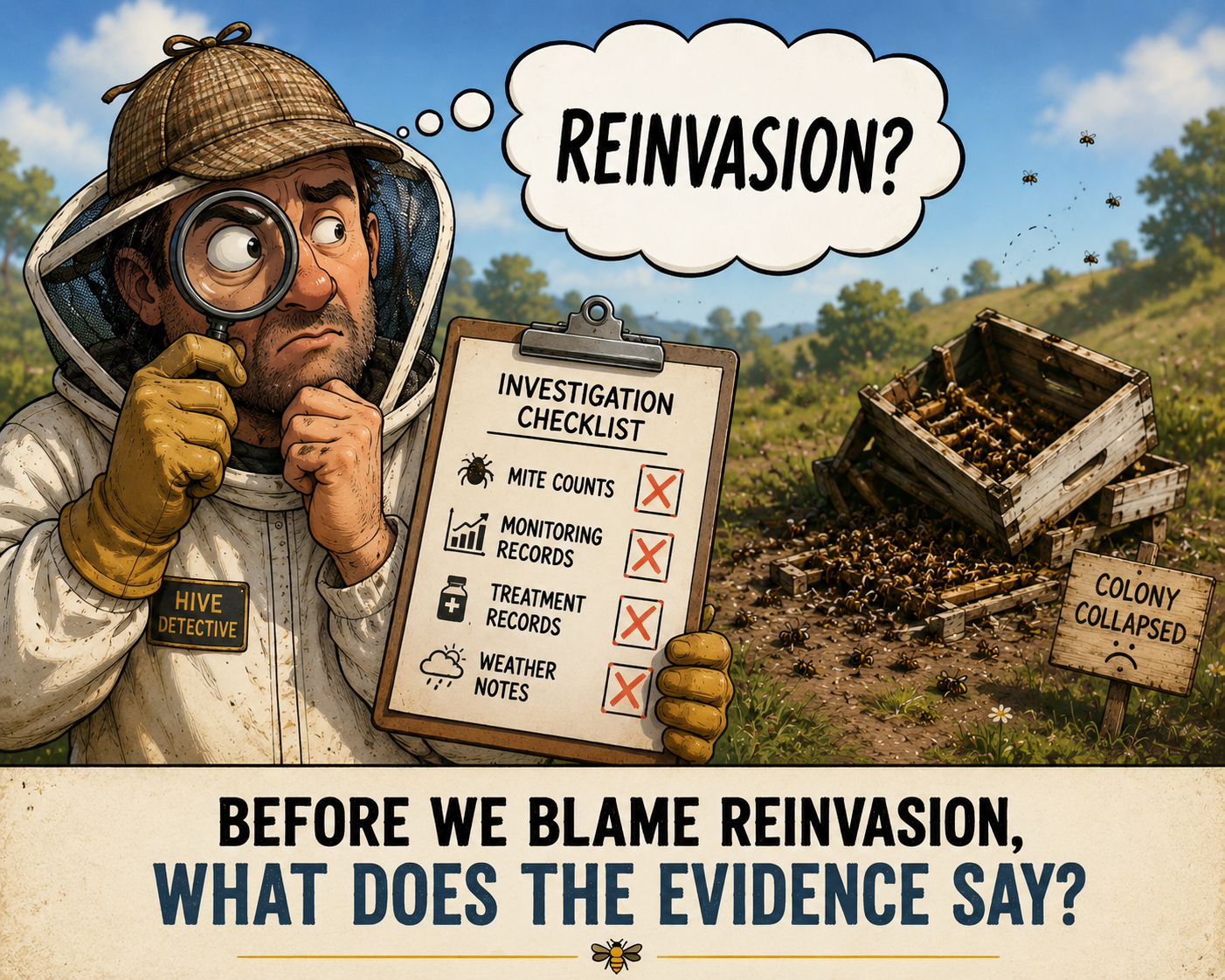
What Do Your Records Say?
When mite numbers rise, the first question should not be:
"Who gave me mites?"
The first question should be:
"What do my records tell me?"
Without monitoring, it becomes almost impossible to separate reinvasion from normal mite population growth, treatment failure, seasonal brood expansion, or management issues.
Varroa populations are designed to grow. Every brood cycle provides new opportunities for mites to reproduce. In a colony with ample brood and favourable conditions, mite numbers can increase substantially without a single mite arriving from outside the apiary.
Monitoring provides the context needed to understand what is actually happening.
Without data, we're left with assumptions.
Our Own Experience
What has made me think about this recently is what we have observed within our own operation.
Over recent months, we have seen reports of colony collapses and significant varroa problems in apiaries relatively close to our own. By the reinvasion theory alone, we should perhaps be seeing dramatic increases in mite numbers.
Instead, what we have observed is something different.
Our mite counts have been rising, but they have been rising gradually.
Not exploding.
Not suddenly jumping from low levels to catastrophic levels overnight.
Instead, we have seen the kind of slow increase that might be expected from ongoing population growth combined with normal environmental pressure.
That doesn't prove reinvasion isn't occurring.
In fact, some level of reinvasion is probably occurring all the time.
What it does demonstrate is that without monitoring, it would be very easy to look at a rising mite count and immediately blame neighbouring colonies while ignoring what may simply be the natural progression of the mite population within the hive itself.
The Difference Between an Event and a Trend
This is where monitoring becomes incredibly valuable.
A single mite count tells you where you are today.
A series of mite counts tells you the story.
The trend often matters more than the number itself.
A colony moving from 3 mites to 5 mites to 8 mites over several months is telling a very different story from a colony that jumps from 3 mites to 25 mites in a short period.
One may indicate gradual population growth.
The other may indicate a significant event, such as treatment failure, collapsing colonies nearby, robbing pressure, or genuine reinvasion.
Without historical records, those two situations can look identical.
Why HiveCast AI Matters
This is one of the reasons we are developing HiveCast AI.
The goal is not simply to record mite counts.
The goal is to provide context.
Imagine two beekeepers entering exactly the same alcohol wash result.
Twenty mites.
On paper, they look identical.
But what if one beekeeper's previous counts were:
5 mites
8 mites
12 mites
16 mites
20 mites
While the other beekeeper's previous counts were:
2 mites
3 mites
4 mites
5 mites
20 mites
Those are completely different situations.
One shows a gradual trend.
The other shows a sudden change.
The number alone doesn't tell the full story.
The trend does.
Over time, platforms like HiveCast AI may help identify these patterns at a much larger scale. By combining monitoring records, weather conditions, seasonal brood patterns, management practices and regional signals, we can begin to understand whether we are looking at normal population growth or something more unusual.
Not guess.
Not assume.
Understand.
Moving Beyond Assumptions
As varroa becomes a permanent part of Australian beekeeping, I believe one of the biggest shifts we need to make is moving from explanation-based beekeeping to evidence-based beekeeping.
Reinvasion is real.
Treatment resistance is real.
Management issues are real.
Seasonal brood dynamics are real.
The challenge is determining which factor is driving the result we are seeing.
That answer rarely comes from a Facebook comment, a rumour, or a theory.
It comes from monitoring.
Because the beekeepers most likely to identify a genuine reinvasion event are usually the ones collecting enough data to recognise that something unusual has happened.
And sometimes the most important question isn't whether reinvasion occurred.
It's whether we have enough information to know the difference.